The Language
Pennsylvania Dutch did not arrive on a ship fully formed. It was created in America during the 18th century — assembled, generation by generation, from a jumble of European dialects brought together in the cornfields of colonial Pennsylvania.
The Founding Period (c. 1700–1800)
Roughly 81,000 German-speaking immigrants arrived in colonial Pennsylvania during the 18th century, and they did not all speak the same dialect. Some spoke variations of Palatine German, others spoke Alemannic Swiss dialects, others spoke Rhine Franconian varieties from further north. When these speakers settled together in rural Pennsylvania — and when, crucially, the flow of new immigrants slowed dramatically between roughly 1760 and 1820 — their children grew up hearing this jumble of dialects and unconsciously smoothed it out into a single new variety.
Linguists call this process dialect leveling. The result was a dialect closely resembling the rural eastern Palatine German spoken around Mannheim and Ludwigshafen, but with its own unique features born of the leveling process. Even today, when Pennsylvania Dutch speakers meet someone from the Palatinate region of Germany, the two can usually understand each other with some effort — a remarkable fact considering nearly 300 years of separation.
Linguistic Classification
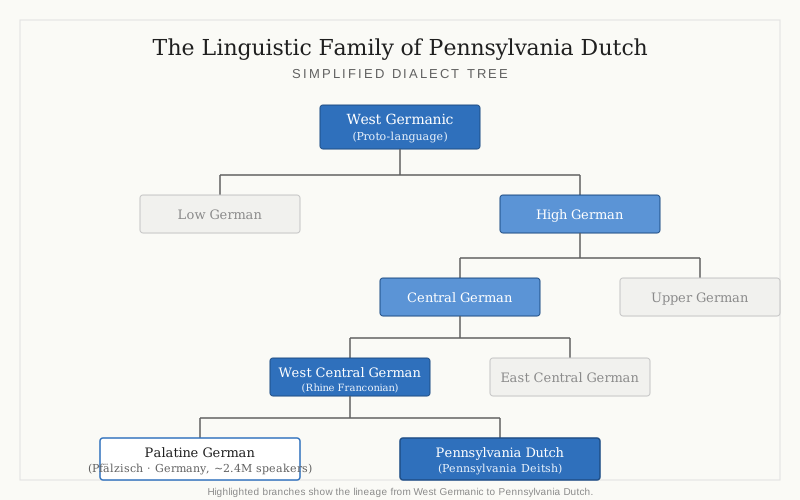
Pennsylvania Dutch is classified as a variety of West Central German, specifically within the Rhine Franconian branch. Its closest living relative is the Palatine German still spoken by about 2.4 million people in the Rhine-Neckar region of Germany.
Whether it is properly called a "language" or a "dialect" is debated. Linguistically, the line between the two is blurry; politically and culturally, many speakers and scholars now treat it as a language in its own right.
What the Language Looks Like
Grammar
Pennsylvania Dutch retains the core grammatical structure of German:
- Three grammatical genders — masculine, feminine, and neuter.
- Verb-second word order in main clauses, like German.
- A case system, though simplified. Personal pronouns still distinguish nominative, accusative, and dative, but nouns have largely collapsed into just two cases: a "common" case (covering nominative and accusative) and a dative case.
The loss of much of the dative system is one of the most significant differences from European Palatine German, and linguists still debate whether this was caused by English influence or by internal developments.
Vocabulary
Roughly 80–85% of the core vocabulary comes directly from Palatine German. The remaining 15–20% is borrowed from English, especially for things that did not exist in 18th-century Europe — automobiles, electricity, modern jobs, American foods, and so on. English-borrowed nouns are typically given a German grammatical gender and treated like native words.
The language has also developed unique features through its long isolation:
- Semantic shifts. The verb gleicha meant "to be like, resemble" in old Palatine German, but in Pennsylvania Dutch it has shifted to mean "to like," directly mirroring the English usage. Ich gleich dich means "I like you."
- Calques (word-for-word translations from English). Entire English idioms have been imported as Pennsylvania Dutch phrases. The English expression "throw his weight around" has been translated literally into Pennsylvania Dutch.
- Pronunciation changes. The German gewesen ("been") has become gvest and then grest in many speakers' usage, with the German r turning into something closer to an American English r.
The result is that even a German speaker from the modern Palatinate, hearing a sentence in Pennsylvania Dutch, can sometimes recognize every individual word and still have no idea what the sentence means.
Writing
Pennsylvania Dutch has historically been a spoken language. For most of its history, its speakers handled their reading and writing in either Standard German (especially for religious purposes) or English. Two competing spelling systems eventually emerged — the older Buffington–Barba system and the newer Hershberger–Wycliffe system — and the story of how they diverged says a great deal about how speakers understand their language's identity. See the section below for a full discussion.
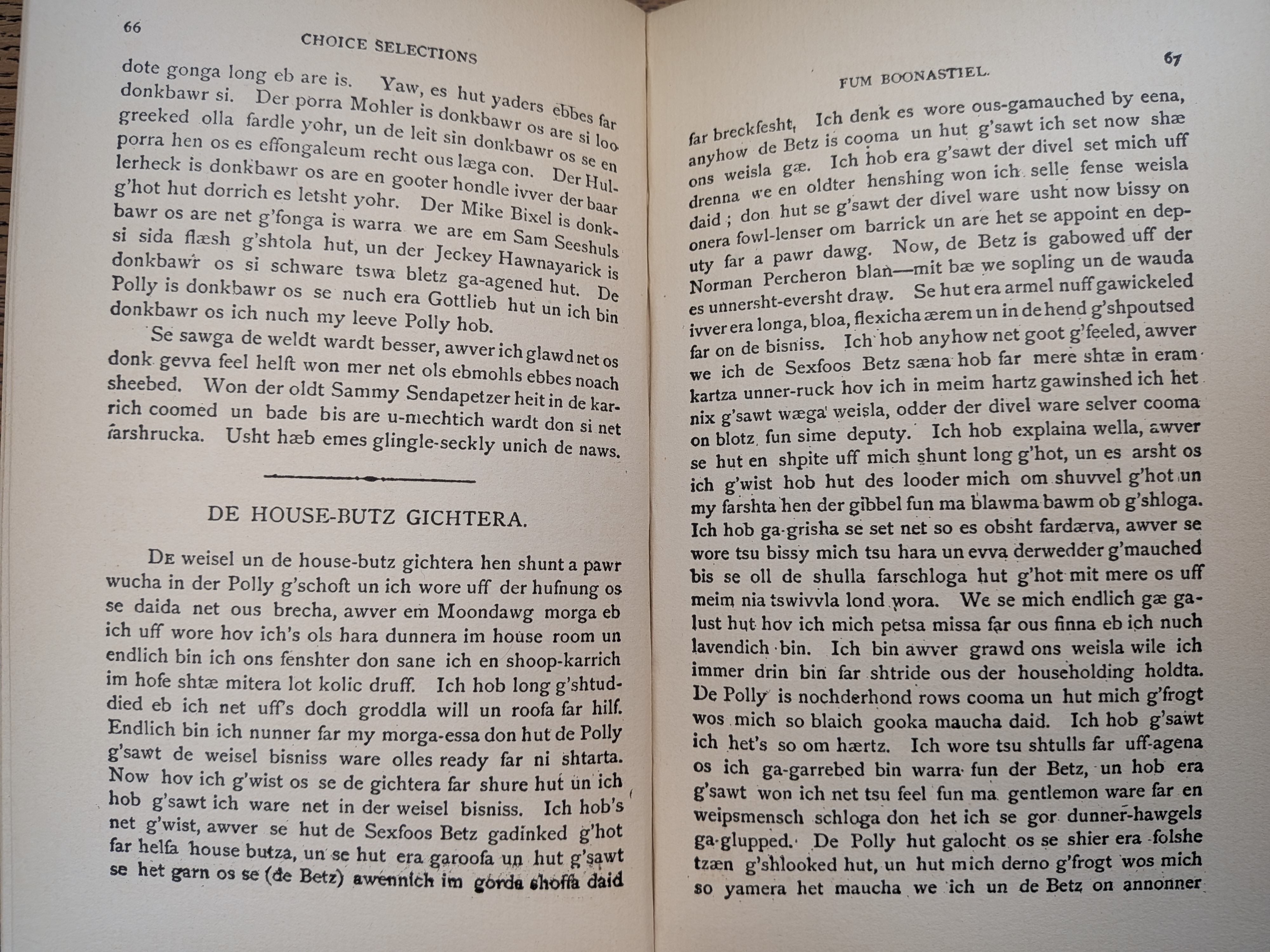
Even so, a real body of literature exists. Beginning around 1800, short pieces in Pennsylvania Dutch began appearing in German-language newspapers in rural Pennsylvania. After the Civil War, longer poems, plays, and stories began to appear, creating a folk literary tradition that survives today.
Lasting Marks on American English
Even outside the speech communities, Pennsylvania Dutch has left fingerprints on regional American English. Words and expressions of Pennsylvania Dutch origin that have spread into broader use include:
- schnickelfritza mischievous child
- spritzto sprinkle or spray
- rutschto slide or fidget
- dippy eggseggs with runny yolks
- "the pie is all"the pie is all gone
- "outen the lights"turn off the lights
These phrases survive in the English of Pennsylvania, parts of Maryland and Ohio, and the cultural memory of millions of Americans whose ancestors once spoke the language at home.
Writing Systems: Two Approaches to Putting Deitsh on the Page
For most of its history, Pennsylvania Dutch was a spoken language. When German was the language of formal religion and printed text in Deitsh communities, there was little pressure to write the dialect down at all — and when people did write it, they improvised, borrowing whatever spelling conventions felt natural. Two competing systems eventually emerged, and they reflect very different ideas about what Deitsh fundamentally is.
The Buffington–Barba System (the older tradition)
The first widely used spelling convention is known as the Buffington–Barba system, named after the linguists Albert F. Buffington and Preston A. Barba who codified it in the mid-twentieth century. This system treats Deitsh as a German dialect first and a separate language second. Its spelling rules borrow heavily from Standard German orthography: words look German on the page even when they are pronounced very differently, and morphological roots tend to stay visible across word forms.
This was the default for academic writing, dictionaries, and the long literary tradition of the so-called Fancy Dutch — newspaper columns, almanacs, poetry, and folklore published by non-sectarian Pennsylvania Germans throughout the 1800s and 1900s.
The Hershberger–Wycliffe System (the newer approach)
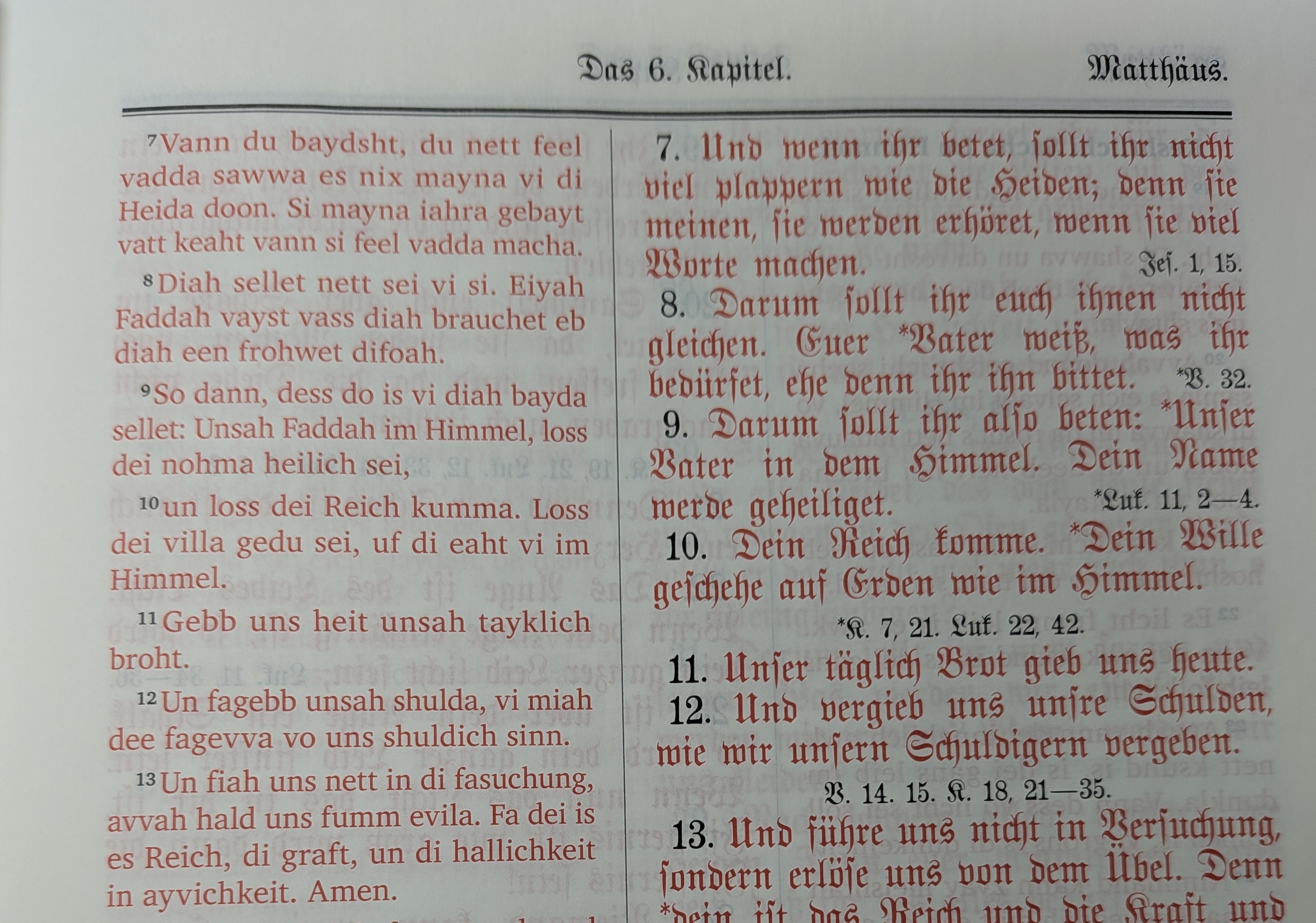
The second system is much younger, and it grew out of a very specific project: the translation of the Bible into Pennsylvania Dutch. It was developed by Hank Hershberger — a native Deitsh speaker who grew up Amish and spent decades as a Wycliffe Bible translator, including twenty-five years in Australia translating the New Testament for the Gugu-Yalanji Aboriginal people — together with a team of fellow speakers.
When Hershberger turned to his own heritage language, he made a deliberate break with the Buffington–Barba tradition. Following the standard practice of Wycliffe translators around the world — adapt the spelling of the dominant national language to the newly written tongue — he based the system on English spelling conventions, not German ones. The result is a writing system with only a few elements in common with either German orthography or the older Buffington–Barba style.
The defining feature of Hershberger–Wycliffe is that it is strongly phonographic: spelling closely tracks pronunciation, and historical or morphemic considerations come second. Many English phoneme-to-letter rules are carried over directly, which makes the system unusually approachable for Deitsh speakers who already read English but have never learned to read German. Loanwords show this tension visibly — some keep their English spelling outright, while others are reshaped to fit Deitsh phonetic rules.
Why It Matters
The split between these two systems is not just a technical quibble. It reflects a deeper question about identity. Buffington–Barba treats Deitsh as a written extension of the German linguistic family — a position that aligns it with centuries of European literary tradition. Hershberger–Wycliffe treats it as an American language whose speakers' literacy is in English, and whose writing should reflect the way it actually sounds in their mouths today. Today, the Hershberger–Wycliffe system is increasingly the working orthography for new published material in Deitsh — including the Pennsylvania Dutch Bible itself, and the body of religious literature being translated into the language by Jehovah's Witnesses (covered on the Today page).
We've seen what the language is. Now: where it stands today, and why it isn't dying.
Sources and Further Reading
- Mark L. Louden, Pennsylvania Dutch: The Story of an American Language (Johns Hopkins University Press)
- Albert F. Buffington and Preston A. Barba — Buffington–Barba Pennsylvania Dutch spelling system (mid-20th century)
- Hank Hershberger and Wycliffe Bible Translators — Hershberger–Wycliffe spelling system, developed in connection with Di Heilich Shrift (2013)
- Max Kade Institute for German-American Studies, University of Wisconsin–Madison — Pennsylvania Dutch Documentation Project
- Britannica, Pennsylvania German