The Language Today
By 1950, almost everyone agreed Pennsylvania Dutch was dying. Almost everyone was wrong. The story of how the language nearly disappeared and then began doubling every twenty years is one of the most surprising in American linguistics.
The 19th Century: The Golden Age
Through most of the 1800s, Pennsylvania Dutch was the dominant everyday language across much of rural southeastern and central Pennsylvania. It was spoken in homes, on farms, in shops, in courtrooms, and on the streets of towns like Reading, Allentown, Lancaster, and York. Children grew up speaking it as their first language and learned English at school. At its peak, it was likely the third most commonly spoken language in the United States, after English and Spanish.
The 20th Century: Pressure and Decline
The decline began in the cities first. By around 1900, Pennsylvania Dutch was already fading as a street language in urban centers like Allentown and Lancaster. Several forces accelerated this:
- Anti-German sentiment during World War I and World War II made speaking any kind of German publicly socially risky and at times outright dangerous.
- Compulsory English-language schooling trained successive generations to view their home language as backward or shameful.
- Mass media — first radio, then television — flooded homes with English-language entertainment, displacing the Pennsylvania Dutch conversations that had once filled family evenings.
- Suburbanization and the breakdown of rural isolation after World War II accelerated assimilation.
Among the Fancy Dutch (Lutheran and Reformed nonsectarians), the shift to English was nearly total within a generation or two after WWII. Many parents, often feeling guilty about it later, simply stopped passing the language on to their children. Today, most remaining nonsectarian speakers are elderly, and the variety is widely considered to be in danger of disappearing among this group.
The Surprising Twist
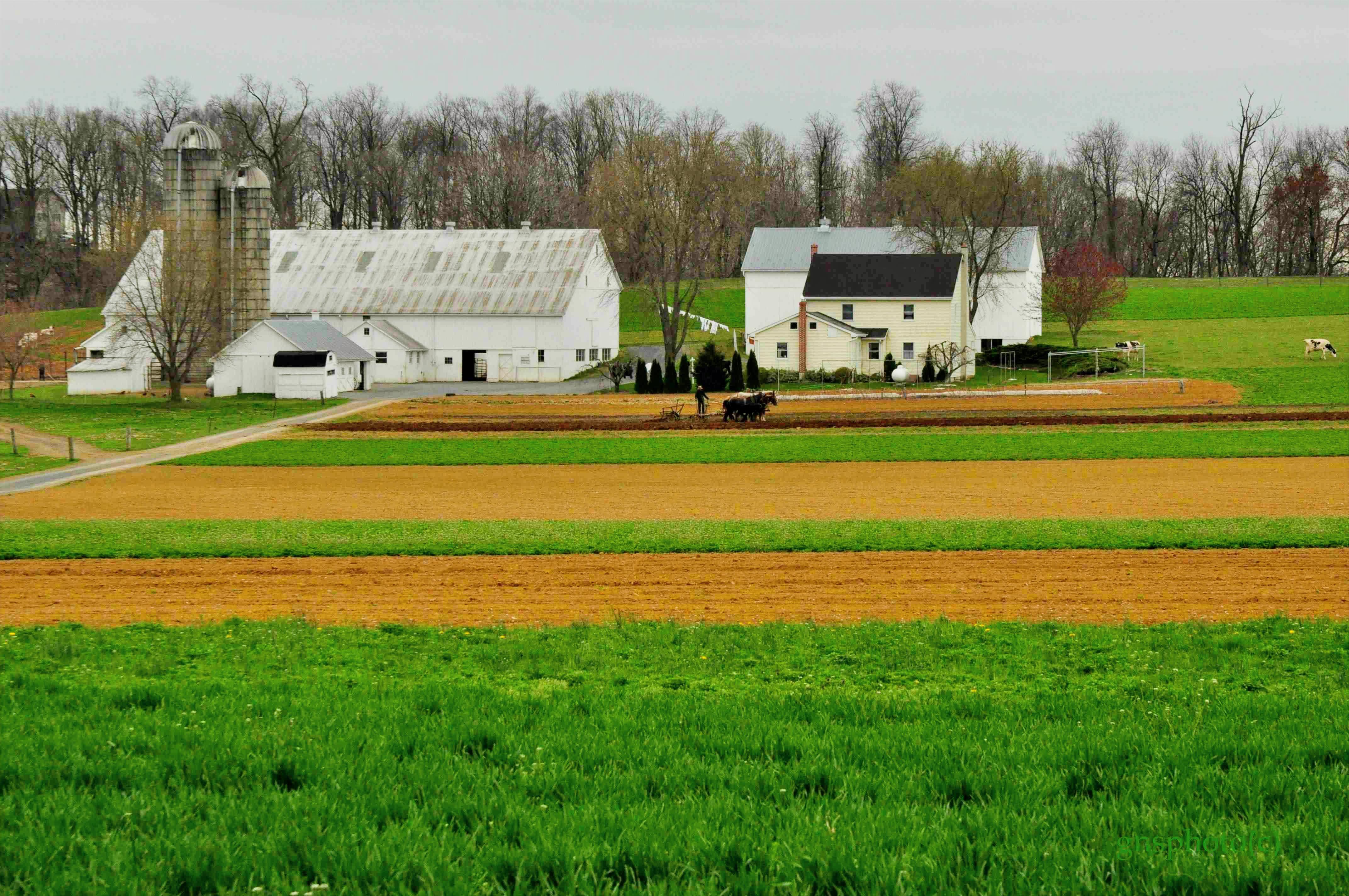
But here is where the story turns. While the Fancy Dutch were assimilating, the Plain Dutch — the Old Order Amish and Old Order Mennonites — were doing the opposite. Their religious commitment to separation from mainstream society meant they kept Pennsylvania Dutch as the everyday language of home, work, and community. They also kept Standard (or "Bible") German for worship, and they learned English for dealing with outsiders, making most of them functionally trilingual.
Because Amish and Old Order Mennonite families typically have very large numbers of children, and because the rate at which young people leave these communities is low, the population of Pennsylvania Dutch speakers has been roughly doubling every twenty years.
Linguist Mark Louden, who has studied Pennsylvania Dutch for decades, has observed that few language communities in the world are growing faster.
Where It Is Spoken
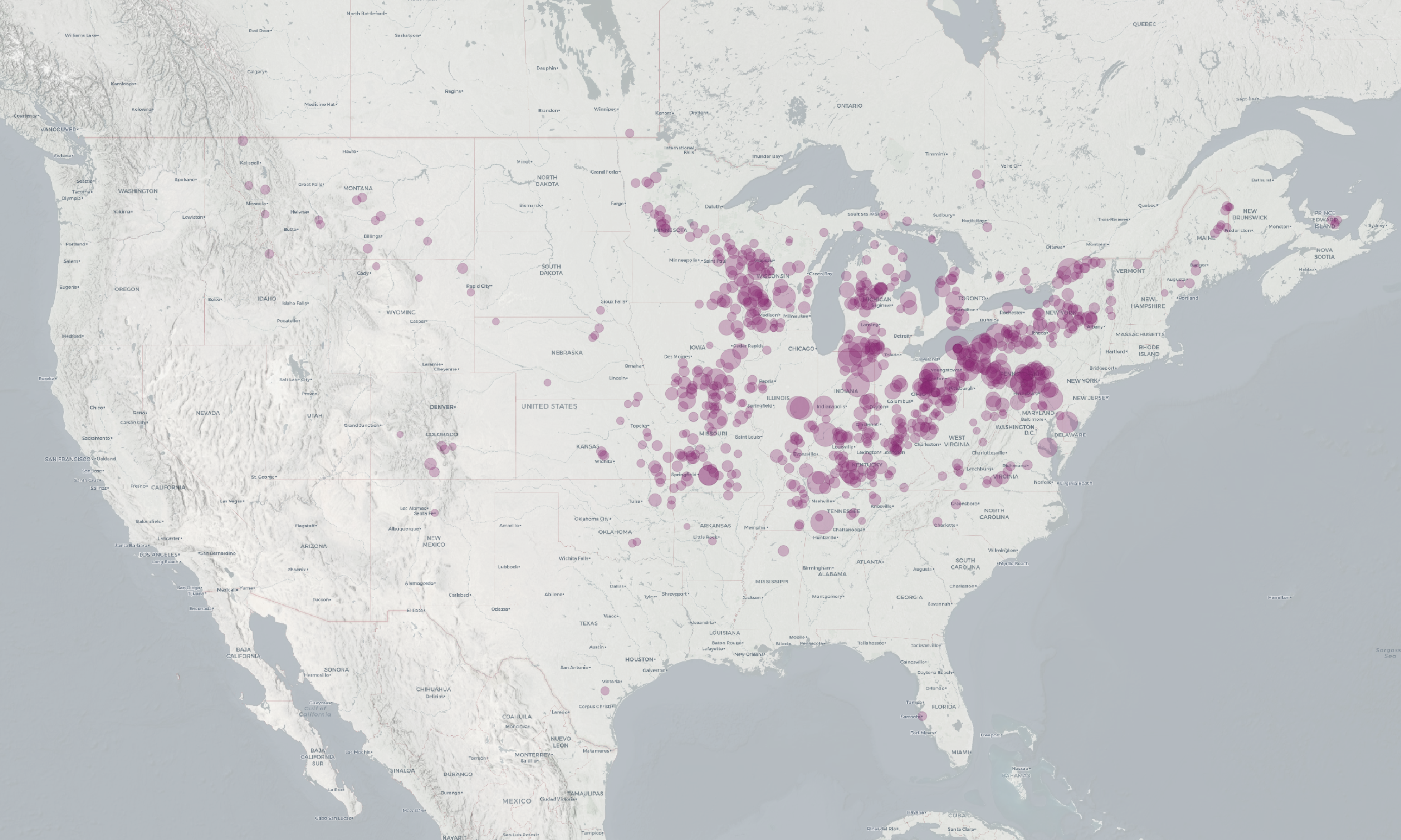
Although the language was born in Pennsylvania, its center of gravity has shifted westward as Plain communities have spread. Today there are an estimated 300,000 to 400,000 native speakers across:
- Pennsylvania — especially Lancaster, Berks, Lehigh, and surrounding counties.
- Ohio — home to one of the largest Amish populations in the world.
- Indiana — particularly the Elkhart-LaGrange and northern Indiana settlements.
- Wisconsin — with over 25,000 Amish speakers, the fourth-largest concentration.
- Other states — including Kentucky, Tennessee, New York, Missouri, Iowa, and many more, totaling more than 30 states overall.
- Ontario, Canada — especially the Waterloo region, where Old Order Mennonites have spoken the language since the early 19th century.
Internal Variation
After centuries of expansion, regional varieties have emerged. Ohio speakers may use English-borrowed words more readily than Pennsylvania speakers (e.g., car instead of Auto). Some Mennonite groups in Ontario retain Swiss German features inherited from their ancestors. Conservative Old Order Amish communities tend to preserve more archaic features, while progressive Mennonite groups incorporate more English influence.
A separate but closely related group, the Swiss Amish (called Shwitzer), speak two related but distinct varieties — Bernese Swiss German and Alsatian German — rather than Pennsylvania Dutch proper. They are descended from later Amish migrants who came directly from Switzerland in the 19th century.
Preservation Efforts
Outside the Plain communities, there are dedicated efforts to keep the language alive among nonsectarians:
- The Grundsow (Groundhog) Lodges — fraternal societies founded in Allentown in 1933 that hold Pennsylvania Dutch-only events, the most famous being a comedic Groundhog Day breakfast.
- University programs, especially the Max Kade Institute for German-American Studies at the University of Wisconsin–Madison, which runs an active Pennsylvania Dutch Documentation Project.
- Folk festivals, community theater in the dialect, and a small but real publishing tradition.
- Online communities and social media groups where learners and heritage speakers exchange phrases, audio recordings, and writing.
The Future
The future of Pennsylvania Dutch is, paradoxically, bright. Linguists studying minority languages around the world note that few are growing as fast. Among Plain communities, children continue to acquire it as a first language, and adults continue to use it daily for work, worship, and family life. As long as the religious commitments and cultural separation of the Old Order communities persist, the language will continue to thrive — likely surpassing one million speakers later this century if current trends continue.
The Fancy Dutch dialect, by contrast, will likely fade as its remaining elderly speakers pass on, taking with it a particular regional flavor and a literary tradition that gave the language much of its written voice. What survives will be different from what came before — but it will survive, which is more than almost any other minority language in North America can claim.
The Bible and Religious Publishing in Deitsh
For most of the language's history, Pennsylvania Dutch had no Bible of its own. Amish and Old Order Mennonite worship has long relied on Martin Luther's sixteenth-century High German translation, even though many speakers acknowledge that Luther's German is increasingly difficult for them to follow. That gap — between the language of the home and the language of the pulpit — is where two very different modern translation projects have stepped in.
Di Heilich Shrift: The Pennsylvania Dutch Bible
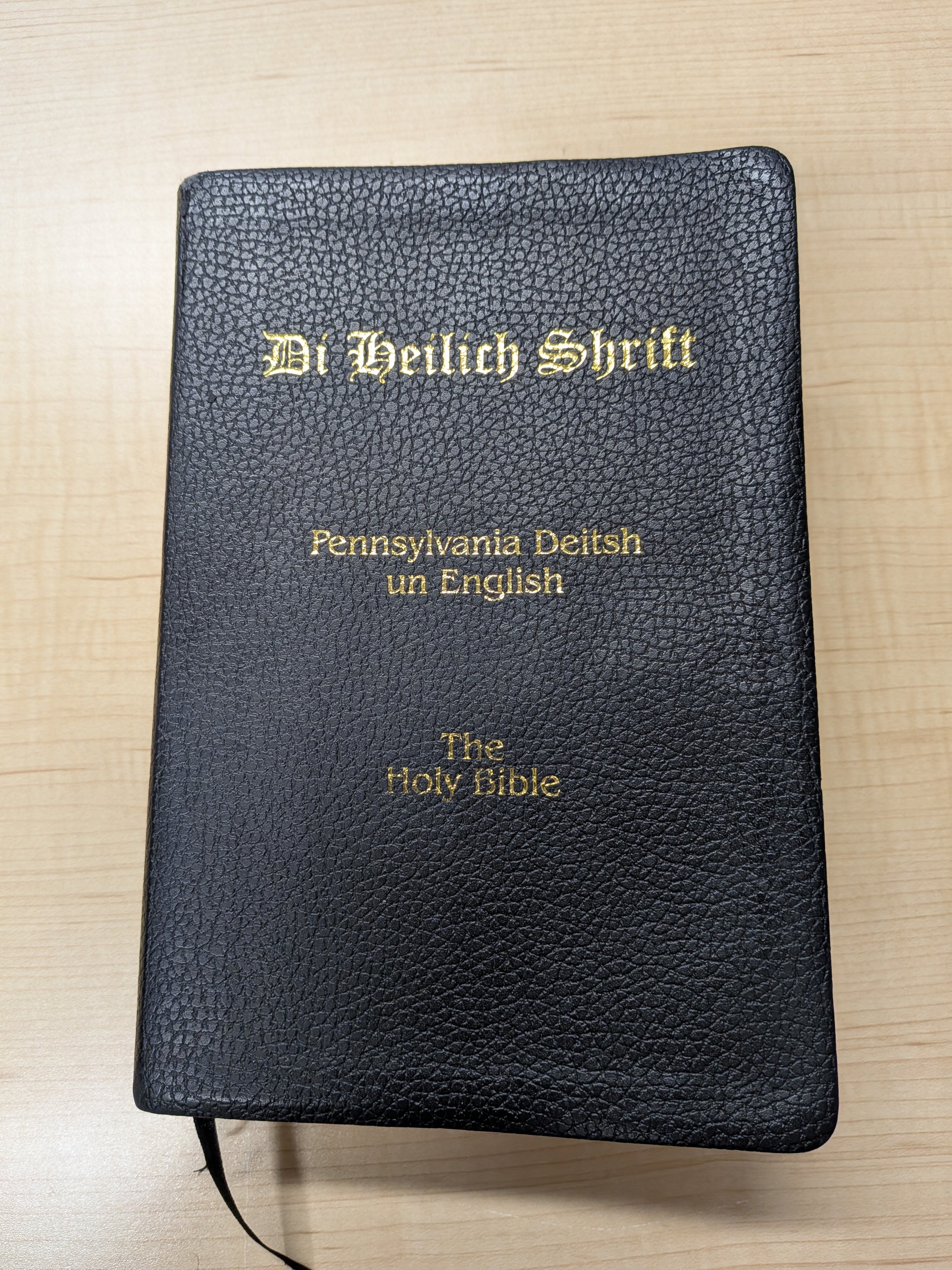
The first complete Bible in Pennsylvania Dutch was published in 2013 under the title Di Heilich Shrift ("The Holy Scripture"), the culmination of decades of work by Hank Hershberger, his wife Ruth, and a team of Amish speakers working with Wycliffe Bible Translators. The project began with the New Testament, Es Nei Teshtament, first published in 1993; by the mid-2010s roughly 20,000 copies of the New Testament had been distributed within Amish communities.
The translation works directly from the original biblical languages — Masoretic Hebrew for the Old Testament and the Textus Receptus Greek for the New Testament — rather than retranslating from Luther or English. Hershberger's stated goal was to give Amish readers Scripture in the language they actually think and pray in. As he put it in interviews, "Our language is not that close to High German," and the resulting confusion had real theological consequences for ordinary readers.
The Pennsylvania Dutch Bible uses the Hershberger–Wycliffe spelling system that Hershberger and his team developed (covered on the Language page). Reception within Amish communities has been mixed. Some families embrace it for home devotions and report that reading Scripture in their mother tongue is emotionally powerful in a way the Luther Bible never was. Many church leaders, however, remain cautious — both because the translation is still relatively new and because the Luther Bible carries deep institutional weight. An audio recording of the Bible by Jacob Tice, released between 2022 and 2025, has further extended the translation's reach, and the text is now available as a free mobile app and on Bible.com.
Jehovah's Witnesses and the Watchtower in Deitsh
A second, very different translation effort is being carried out by Jehovah's Witnesses, who publish a substantial body of religious literature in Pennsylvania Dutch through their official website jw.org. Since at least the late 2010s, selections of The Watchtower — Study Edition and the foundational "Bible Teachings" materials have been translated into Deitsh and made freely available online.
What makes the project unusual is who is doing the work. The translators are not professional linguists. They are a small team of native Deitsh speakers who grew up Old Order Mennonite or Amish before becoming Jehovah's Witnesses. They live in Ohio, home to some of the largest Pennsylvania Dutch-speaking settlements in the country. They were trained for the work in a six-week course, and receive ongoing training on a regular basis which is organized by the Watch Tower Bible and Tract Society. Each text is translated by three team members, with the resulting drafts compared and reconciled before publication. The translations are written in the "plain" sectarian variety of Deitsh — the form actually spoken in Amish and Old Order Mennonite communities today.
This is one of the few sustained efforts to produce contemporary, non-academic prose in Pennsylvania Dutch on a regular publishing schedule, and it has had an unexpected side effect: it has given linguists a uniquely useful body of paired English-Deitsh texts to study, leading directly to the academic work described below.
The ENDE Corpus: Linguistics Catches Up
In 2022, researchers Barbara Hans-Bianchi and Camilla Balsamo at the University of L'Aquila in Italy released the ENDE Corpus (the English–Deitsh Translation Corpus) — the first annotated digital corpus of Pennsylvania German texts ever assembled. Built from 35 monthly issues of The Watchtower — Study Edition (May 2017 through March 2020) plus the Jehovah's Witness "Bible Teachings" materials, used with permission from the Watch Tower Bible and Tract Society of Pennsylvania, it contains roughly 70,000 words of English source text aligned sentence-by-sentence with their Deitsh translations.
The corpus is freely available to researchers at deitsch.eu and it represents a quiet but significant milestone. For most of its existence, Pennsylvania Dutch has lived almost entirely outside of formal scholarly infrastructure. The ENDE corpus is the first time the language has been treated with the same computational-linguistic tools routinely applied to major world languages — lemmatized, part-of-speech tagged, and made queryable — and that, on its own, says something about where the language sits today: very much alive, increasingly written, and finally being studied as an idiom in its own right rather than a footnote to German.
Sources and Further Reading
- Max Kade Institute for German-American Studies, University of Wisconsin–Madison — Pennsylvania Dutch Documentation Project
- Mark L. Louden, Pennsylvania Dutch: The Story of an American Language (Johns Hopkins University Press)
- Britannica, Pennsylvania German
- Pennsylvania Center for the Book (Penn State Libraries)
- Anabaptist Historians, Mennonites, Amish, and the Pennsylvania Dutch Language
- ATA German Language Division publications
- Hank Hershberger and Wycliffe Bible Translators, Di Heilich Shrift (Pennsylvania Dutch Bible, 2013)
- Hank Hershberger and Wycliffe Bible Translators, Es Nei Teshtament (Pennsylvania Dutch New Testament, 1993)
- jw.org — Pennsylvania Dutch publications (Jehovah's Witnesses)
- Barbara Hans-Bianchi and Camilla Balsamo, University of L'Aquila — ENDE Corpus (English–Deitsh Translation Corpus, 2022), available at deitsch.eu